Category Archives: Immigration

Immigration Reform-For the Climate by Bill McKibben

Immigrants come to the U.S. determined to make a new life. So often they’re more open to the kind of changes we’ll need to deal with climate change.
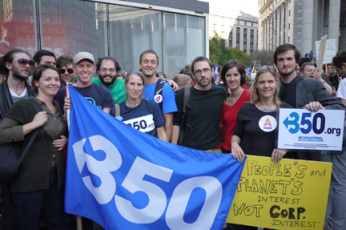
Climate activists with 350.org

Climate activists with 350.org

For environmentalists, population has long been a problem. Many of the things we do wouldn’t cause so much trouble if there weren’t so many of us. It’s why I wrote a book some years ago called Maybe One: An Argument for Smaller Families. Heck, it’s why I had only one child.

And many of us, I think, long viewed immigration through the lens of population; it was another part of the math problem. I’ve always thought we could afford historical levels of immigration, but I understood why some other environmentalists wanted tougher restrictions. More Americans would mean more people making use of the same piece of land, a piece that was already pretty hard-used.

In recent years, though, the math problem has come to look very different to me. It’s one reason I feel it’s urgent that we get real immigration reform, allowing millions to step out of the shadows and on to a broad path toward citizenship. It will help, not hurt, our environmental efforts, and potentially in deep and powerful ways.

One thing that’s changed is the nature of the ecological problem. Now that global warming is arguably the greatest danger we face, it matters a lot less where people live. Carbon dioxide mixes easily in the atmosphere. It makes no difference whether it comes from Puerto Vallarta or Portland.

It’s true that the typical person from a developing nation would produce more carbon once she adopted an American lifestyle, but she also probably would have fewer children. A December report from the Pew Research Center report showed that birthrates in the U.S. were dropping faster among Mexican American women and women who immigrated from Mexico than among any other group.

This is a trend reflected among all Latinas in the U.S. As an immigrant mother of two from the Dominican Republic told the New York Times: “Before, I probably would have been pressured to have more, [but] living in the United States, I don’t have family members close by to help me, and it takes a village to raise a child. So the feeling is, keep what you have right now.” Her two grandmothers had had a total of 27 children. The carbon math, in other words, may well be a wash.

But there’s a higher math here that matters much more. At this point, there’s no chance we’re going to deal with global warming one household at a time—scientists, policy wonks and economists have concluded it will also require structural change. We may need, for example, things such as a serious tax on carbon; that will require mustering political will to stand up to the fossil fuel industry.

And that’s precisely where white America has fallen short. Election after election, native-born and long-standing citizens pull the lever for climate deniers, for people who want to shut down the Environmental Protection Agency, for the politicians who take huge quantities of cash from the Koch brothers and other oil barons. By contrast, a 2012 report by the Sierra Club and the National Council of La Raza found that Latinos were eager for environmental progress. Seventy-seven percent of Latino voters think climate change is already happening, compared with just 52% of the general population; 92% of Latinos think we have “a moral responsibility to take care of God’s creation here on Earth.”

These numbers reflect, in part, the reality of life for those closer to the bottom of our economy. Latinos are 30% more likely to end up in the hospital for asthma, in part because they often live closer to sources of pollution.

But immigrants, by definition, are full of hope. They’ve come to a new place determined to make a new life, risking much for opportunity. They’re confident that new kinds of prosperity are possible. The future beckons them, and so changes of the kind we’ll need to deal with climate change are easier to conceive.

Republicans think immigrants are a natural fit for their party, and I hope they’re at least partly right—some force needs to help ease the Republicans out of their love affair with ideology and back into a relationship with reality. As commentator Bill O’Reilly put it as he watched Mitt Romney lose despite gaining a huge majority of white votes, “it’s not a traditional America anymore.”

He’s right. And for the environment, that’s good news. We need immigrants to this nation engaged in public life, as soon and as fully as possible. It’s not just the moral thing to do, it’s a key to our future.

Bill McKibben, a professor at Middlebury College, is the author of many books and the founder of 350.org. He is dedicated to fighting climate disaster. Source: Los Angeles Times, March 14, 2013.

The U.S.-Canada border.

The U.S.-Canada border.

The U.S.-Mexico border

The U.S.-Mexico border

COUNTERPOINT: Bill McKibben’s Magical Thinking on Immigration, Population Growth, and Climate Change by Leon Kolankiewicz

Bill McKibben, climate activist, author of the landmark book The End of Nature, and founder of the group 350.org, is deservedly recognized as one of America’s leading contemporary environmentalists.

Many of these same leading contemporary environmentalists assiduously dodge one of the most important environmental issues of all—population. Overpopulation is considered a politically inconvenient and polarizing distraction. Worse yet, it is entangled (often falsely) in the public imagination with a host of other hot-button issues and even travesties—religion, sex, women’s rights, birth control, abortion, immigration, forced sterilization, China’s one-child policy, and eugenics, just to name a few. Thus, it’s not surprising, but still disappointing, that leading environmentalists and their organizations prefer to duck population.

Not Bill McKibben. He forthrightly acknowledges that, “many of the things we do wouldn’t cause so much trouble if there weren’t so many of us.” After all, it is common sense and simple arithmetic – the more of us there are using up resources and excreting wastes, the greater our aggregate burden on the environment, including the climate.

Even conscientious environmentalists like McKibben inexorably leave behind some ecological and carbon footprint or legacy—if a somewhat smaller one than the average apathetic American. It goes with the territory called living. And the more we consume to live well, to enjoy a higher standard of living and the quality of life that often but not always goes with it, the deeper and larger the ecological footprint we impose on a beleaguered biosphere.

For years McKibben’s position on population displayed a common sense all too uncommon among the nation’s politically correct environmental establishment. But now he appears to have taken leave of his senses. Inexplicably, in a recent op-ed in the Los Angeles Times, he promotes not only amnesty for illegal immigrants but argues more generally that expansive immigration policies —in effect, higher immigration rates—will help America address climate change. He admits this will boost America’s population in a land that is already “pretty hard-used.” And yet, in his magic formula, more people will magically emit less carbon dioxide.

How can that be? In what McKibben calls “a higher math” and what I call an extraordinary, unfounded leap of faith, he claims that immigrants, particularly Latino immigrants, yearn not just for a higher standard of living—which is, after all, why most of them come to America—but to save the Earth from runaway global warming. He fanaticizes they are more likely to embrace a carbon tax, for instance, and to evince a determination to face down the entrenched fossil fuel industry.

His argument boils down to this: Americans are selfish and short-sighted sinners, and immigrants are the saints who might just save us from our own sinful ways.

On what evidence does McKibben base this feckless faith? His fetching belief that, “immigrants, by definition, are full of hope” and his misplaced confidence in a dubious 2012 survey by the Sierra Club and the National Council of La Raza that claimed, “Latinos were eager for environmental progress.”

The Sierra Club is the same purportedly environmental organization that back in the 1990s abandoned an earlier commitment to U.S. population stabilization to appease open borders advocates. La Raza (“The Race” in Spanish) is the largest national Latino advocacy organization. It has long pushed amnesties and what amounts to open borders—what it thinks of as good for its own ethnic constituency—but with disdain for America’s sovereignty and well-being as a whole, as well as utter disregard for environmental sustainability in general.

In other words, the 2012 report McKibben cites is highly suspect. What appears to be at work is political expediency orchestrated by operatives in the Democratic Party, or “you scratch my back and I’ll scratch yours.” I’ll support amnesty if you support or at least give lip service to climate advocacy.

In a 2008 research paper, I estimated CO2 emissions of the average immigrant (legal and illegal combined) in the U.S. at 18% less than those of the average native-born American. However, these same immigrants produced four times more CO2 in the U.S. than they would have in their countries of origin. The average Mexican immigrant to the U.S. generated only half the CO2 emissions of the average native born American but three times as much CO2 as the average Mexican who stayed in Mexico. Elevated CO2 emissions of immigrants to the U.S. accounted for about 5% of the total increase in annual worldwide CO2 emissions from 1980 to 2008.

My skepticism about the 2012 Sierra Club-La Raza findings that McKibben says fill him with such hope is informed by three years as a Peace Corps Volunteer in Latin America and more than 20 years of marriage to an immigrant Latina, fluency in Spanish, and two decades of personal involvement with the Latino immigrant experience here in the U.S.

The Central Americans I lived and worked with in the Peace Corps were decidedly less concerned about the environment than North Americans. This was not because of any ethical shortcomings on their part but because of the pressing need to make ends meet and an understandable focus on improving their precarious material standard of living. Rather than worrying about the disappearing tropical rainforests of their country, or the nauseating contamination in the river that ran through town (so polluted you could smell it before you saw it), my wife’s family in a Tegucigalpa, Honduras shantytown was more concerned with trying to get a toilet and indoor plumbing to replace their old wooden outhouse. And replacing the old 55-gallon drum out back on which they cooked with firewood with an actual indoor electric stove was a much higher priority than saving polar bears endangered by disappearing Arctic ice from a warming climate. Such lofty concerns were a luxury my in-laws could not afford.

With the noteworthy exception of tiny Costa Rica (which sends few immigrants here) and its vaunted national parks system, not one Latin American country is widely considered a beacon of enlightened environmental policy and management. Are the immigrants who hail from these countries all that different? If so, they haven’t shown it by joining and supporting American environmental advocacy organizations in large numbers. But maybe at least in part this is because they aren’t made to feel welcome in these same groups that avoid the immigration issue so as to not appear unwelcoming to immigrants.

To believe that immigrants and their U.S.-born descendants will display an enlightened environmental ethic and advocacy so strong that it will more than offset the increased environmental burden of their burgeoning numbers is nothing short of preposterous. It is magical thinking on an outrageous scale.

By advocating amnesty and essentially unlimited immigration to any and all comers, Bill McKibben would doom America to population growth with no end in sight, and sacrifice America’s environment and its response to climate change on the altar of political expediency masquerading as “the moral thing to do.”

Leon Kolankiewicz is a professional environmental scientist and planner who has researched and written extensively about immigration, U.S. population growth, and the environment.

3 Comments

Filed under Climate, Immigration, Population, Sustainability

U.S. Immigration Policies: Uncomfortable Facts by Paul Krugman

(This article was written in 2006, and it’s still relevant today)

Paul Krugman

Paul Krugman

“Give me your tired, your poor, your huddled masses yearning to breathe free,” wrote Emma Lazarus, in a poem that still puts a lump in my throat. I’m proud of America’s immigrant history, and grateful that the door was open when my grandparents fled Russia.

In other words, I’m instinctively, emotionally pro-immigration. But a review of serious, nonpartisan research reveals some uncomfortable facts about the economics of modern immigration, and immigration from Mexico in particular. If people like me are going to respond effectively to anti-immigrant demagogues, we have to acknowledge those facts.

First, the net benefits to the U.S. economy from immigration, aside from the large gains to the immigrants themselves, are small. Realistic estimates suggest that immigration since 1980 has raised the total income of native-born Americans by no more than a fraction of 1%.

Second, while immigration may have raised overall income slightly, many of the worst-off native-born Americans are hurt by immigration—especially immigration from Mexico. Because Mexican immigrants have much less education than the average U.S. worker, they increase the supply of less-skilled labor, driving down the wages of the worst-paid Americans. The most authoritative recent study of this effect, by George Borjas and Lawrence Katz of Harvard, estimates that U.S. high school dropouts would earn as much as 8% more if it weren’t for Mexican immigration.

That’s why it’s intellectually dishonest to say, as President Bush does, that immigrants do “jobs that Americans will not do.” The willingness of Americans to do a job depends on how much that job pays—and the reason some jobs pay too little to attract native-born Americans is competition from poorly paid immigrants.

Finally, modern America is a welfare state, even if our social safety net has more holes in it than it should—and low-skill immigrants threaten to unravel that safety net.

Basic decency requires that we provide immigrants, once they’re here, with essential health care, education for their children, and more. As the Swiss writer Max Frisch wrote about his own country’s experience with immigration, ”We wanted a labor force, but human beings came.” Unfortunately, low-skill immigrants don’t pay enough taxes to cover the cost of the benefits they receive.

Worse yet, immigration penalizes governments that act humanely. Immigrants are a much more serious fiscal problem in California than in Texas which treats the poor and unlucky harshly, regardless of where they were born.

We shouldn’t exaggerate these problems. Mexican immigration, says the Borjas-Katz study, has played only a “modest role” in growing U.S. inequality. And the political threat that low-skill immigration poses to the welfare state is more serious than the fiscal threat: the disastrous Medicare drug bill alone does far more to undermine the finances of our social insurance system than the whole burden of dealing with illegal immigrants. But modest problems are still real problems, and immigration is becoming a major political issue. What are we going to do about it?

Realistically, we’ll need to reduce the inflow of low-skill immigrants. Mainly that means better controls on illegal immigration. But the harsh anti-immigration legislation passed by the House, which has led to huge protests—legislation that would, among other things, make it a criminal act to provide an illegal immigrant with medical care—is simply immoral.

Meanwhile, Mr. Bush’s plan for a ”guest worker” program is clearly designed by and for corporate interests, who’d love to have a low-wage work force that couldn’t vote. Not only is it deeply un-American; it does nothing to reduce the adverse effect of immigration on wages. And because guest workers would face the prospect of deportation after a few years, they would have no incentive to become integrated into our society.

What about a guest-worker program that includes a clearer route to citizenship? I’d still be careful. Whatever the bill’s intentions, it could all too easily end up having the same effect as the Bush plan in practice—that is, it could create a permanent underclass of disenfranchised workers.

We need to do something about immigration, and soon. But I’d rather see Congress fail to agree on anything than have it rush into ill-considered legislation that betrays our moral and democratic principles.


Dr. Paul Krugman, American economist, bestselling author and respected professor, was awarded the prestigious Nobel Prize in Economics in 2008. Krugman’s expertise is in international economics, including finance, trade theory and economic geography. Source: This essay was published by Paul Krugman in the New York Times on March 27, 2006. It is reprinted here verbatim and unedited. In follow-up remarks Krugman noted that although many readers will probably be unhappy with the essay, he stands by its main points, referencing economic studies which support those points. Interestingly, the NY Times quickly deleted the original article from its website.

Leave a Comment

Filed under Economy, Ethics, Growth, Human Rights, Immigration, Leadership, Sustainability

Open Borders and the Tragedy of Open Access Commons by Herman Daly

Immigrants are people, and deserve to be well treated; immigration is a policy, and deserves rational discussion.

Immigration is a divisive issue. A good unifying point in discussing it is to recognize that every country in the world has a policy of limiting immigration. Some allow many legal immigrants. Other countries (China and Japan, for example) allow very few. As the World Bank reported in its Global Bilateral Migration Database, “The United States remains the most important migrant destination in the world, home to one fifth of the world’s migrants and the top destination for migrants from no less than sixty sending countries. Migration to Western Europe remains largely from elsewhere in Europe.”

Herman Daly

Herman Daly

Questions of how many immigrants are consistent with the welfare of the receiving community, and which prospective immigrants should get priority, are legitimate, and are answered differently in different countries. There are political arguments in every country for more or for less immigration, and for different selection criteria. There are also arguments about freedom to emigrate—what are the obligations of emigrants to the community that educated and invested in them (e.g. the brain drain)?

Immigrants are people, and deserve to be well treated; immigration is a policy, and deserves rational discussion. It seems that neither expectation is adequately fulfilled, perhaps partly because the world has moved from largely empty to quite full in only one lifetime. What could work in the world of two billion people into which I was born, no longer works with today’s world of seven billion. In addition to people the exploding populations of cars, buildings, livestock, ships, refrigerators, cell phones, and even corn stalks and soybean plants, contribute to a world full of “dissipative structures” that, like human bodies, require a metabolic flow of resources beginning with depletion and ending with pollution. This growing entropic throughput already exceeds ecological capacities of regeneration and absorption, degrading the life-support capacity of the ecosphere.

The U.S. is indeed a country of immigrants; but it is also a country of law. Within the rule of law there is a wide range of legitimate opinion about what limits and priorities best balance the interests of the sending and receiving communities, and of the individual migrants. In the US most population growth is due to net immigration, so population stabilization absolutely requires immigration limits. To advocate population stability while refusing to accept limits to immigration is self-contradictory. Some open-borders advocates argue that because population at a global level is the result only of birth and death rates (migration is irrelevant since the Earth does not receive people from other planets)—that therefore nations should not be concerned with immigration as a cause of their own population growth, but only with their own natural rate of increase. This is a non sequitur. With open borders, why would any country any longer try to limit its birth rate, if it is (a) possible to export its excess population, and, (b) impossible to limit its population, given unlimited immigration? Evading an issue by “globalizing” it is a cop-out.

In addition we have in the U.S. a strong cheap-labor lobby that uses immigration (especially illegal immigration) to force down wages and break labor unions, as well as weaken labor safety standards. This is less the fault of the immigrants than of our own elite employing class and pandering politicians. The immigration issue in the U.S. is largely an internal class battle between labor and capital, with immigrants as pawns in the conflict. This class division is more important than racial issues, which nevertheless receive more attention because racial discrimination is rightly illegal, whereas class exploitation is often legal, protected by laws that need to be democratically changed—just have a look at the U.S. tax code, or the Citizens United ruling of the Supreme Court.

Unlike Europe, the U.S. has a large population of citizens whose recent ancestors were forcefully brought over as slaves (involuntary immigrants). Many Americans, including me, think that Black American heirs of slavery deserve priority in the U.S. job market (including job training) over new immigrants, especially illegal immigrants. Likewise for the many Americans of all races still living in poverty. Other Americans, unfortunately, seem to feel that if we can’t have slaves, then the next best thing is abundant cheap labor—another way of saying lots of poor people! Nevertheless, I would favor temporary legal immigration at about half of the current level of one million per year, but diminishing gradually every year to a level consistent with population stability. Population stability means that births plus immigrants equal deaths plus emigrants.

What immigration policy would critics of U.S. immigration limits advocate for other countries? Say for Japan, or Germany, or Greece, or for an independent Catalonia, if that should come about? Do any political parties in member countries advocate open borders for the European Union with respect to the rest of the world? Should the areas of the Amazon reserved for indigenous people be open to free immigration? Should Bhutan, bordered by the world’s two most populous countries and trying to preserve its culture and ecosystems, declare a policy of open borders?

Outside the rule of law there is of course illegal immigration that renders moot all democratic policy deliberations about balancing interests for the common good. Again, there are legitimate questions about how best to enforce immigration laws, making the punishment fit the crime, etc. But it is hardly democratic to refuse to enforce democratically enacted laws, even though difficult individual cases arise, as with any law. Humane provisions for difficult cases must be worked out, e.g., children brought here illegally by their parents twenty years ago.

Some people propose quite a drastic change in immigration law. They advocate a policy of open borders, which at a stroke would do away with illegal immigration and enforcement problems. This is at least a more honest position than just refusing to enforce democratically enacted laws. It is attractive to anarchists, if there are any left, and to libertarians, their modern descendants. Libertarians are mainly found today among neoclassical economists, whose view is that of atomistic individualism. Only the individual is real. The community is just an aggregate of individuals, nothing more. Their focus is on individuals maximizing their own welfare. Since the community is not considered real they commonly neglect effects of mass immigration, both positive and negative, on both the sending and receiving community. They see the world as one big free market, which of course entails free mobility of labor, as well as goods and capital—a globally integrated economy all guided by a global invisible hand—deregulation taken to the limit! In developed countries they are especially interested in opening their borders to young workers to help cover social security shortfalls resulting from the older age structure caused by slower population growth. The cheap-labor lobby is joined by the cheap- retirement lobby. Apparently the immigrants are expected to die or go home as soon as they reach retirement age and would start receiving rather than paying into social security. Also, while working they are expected to boost fertility and population growth sufficiently to postpone the necessity of raising the retirement age or lowering benefits. Population growth is expected to continue indefinitely.

Even some environmentally-minded economists seem to favor open borders. They have swallowed the basic atomistic individualism of neoclassical economics while opposing other aspects of the paradigm. Nevertheless, people are in fact not atomistic individuals but persons-in-community—both social and biophysical community. Our very identity as persons is constituted by internal relations in community—with family, friends, and place, including one’s ties to country, biome, customs, religion, language, and history. Community is real and important to the welfare of real persons—it is not just an aggregate of externally related, atomistic, interchangeable individuals—of “economic men” running all over the world in mass numbers seeking their own utility maximization.

Within limits individual freedom to migrate is certainly a value to be protected—including against its own self-defeating extreme of open borders. To make political progress toward consensus on immigration policy we should first clear the air with a “referendum” on the policy of open borders. If that policy is rejected then we can talk seriously about the total number of immigrants and the selection criteria that best balance the needs of all people. If the open-borders policy is adopted then one must forget about controlling the movement of people across national boundaries.

Indeed, open borders eliminates or at least diminishes control of the border crossings of goods and capital as well—something consistently advocated by neoclassical economists under the banner of “free trade” and “globalization”. National boundaries are in effect erased, and without national boundaries there need be no border patrol, indeed no military to defend those former borders—just one big happy “world without borders” in the words of the song. After two world wars the abolition of the nation state admittedly has its appeal—but a “world without borders” is an expression of sentimentality, not reason. If you are poor and your country provides no social safety net, you move to one that does. If you are rich and your country makes you pay your taxes, you move to one that doesn’t. That is the “world without borders” —and without community either!

Global community must be a “community of communities”, a federation of nations cooperating for a limited number of important global purposes. Erasure of national boundaries would mean that there are no communities left to federate. The invisible hand of the free global market (along with unrestrained global corporations) will unleash growth in global GDP (unhindered by national policies of cost internalization). The population of atomistic cosmopolitan individuals, free from national laws and constraints, will grow with renewed pace. External costs, if recognized at all, will presumably fall on the “non-existent” community, and to the extent that some fall on real individuals, they can be escaped by freely migrating somewhere else.

Realistically however, a policy of open borders obviously invites the tragedy of the open access commons. It is its own reductio ad absurdum, as indicated in the previous paragraph. Probably that is why, in the full world of today, no country practices it, and few people advocate it. Nevertheless, it should be fairly discussed, because some people certainly do advocate it. In addition to the cheap-labor and cheap-retirement lobbies, advocacy of open borders comes both from the politically correct faction of left-wing economists, and from the libertarian faction right-wing economists. The politically correct reflexively label any limits on immigration as thinly disguised “racism”, apparently the only evil they can recognize. The libertarian neoclassicals label any restriction on immigration as a “market distortion”, their single cardinal sin. Both consider themselves advanced cosmopolitans, morally superior to the national populists whose “provincial” concern is first for the poor in their own community. This surprising agreement between opposite political extremes in support of open borders is evidence that ideologues of both types have difficulty thinking clearly. Unfortunately, lack of clear thinking—aided by moralistic pretension, ethnic politics, and class interest—is often a political advantage.


Herman E. Daly is one of the world’s foremost ecological economists. He is Emeritus Professor at the University of Maryland, School of Public Policy. From 1988 to 1994 he was Senior Economist in the Environment Department of the World Bank. His interest in economic development, population, resources, and environment has resulted in over a hundred articles in professional journals and anthologies, as well as numerous books, including Toward a Steady-State Economy. He is co-author with theologian John B. Cobb, Jr. of For the Common Good which received the 1991 Grawemeyer Award for Ideas for Improving World Order. Over his career, Herman has taken a courageous stance, swimming upstream against the currents of conventional economic thought. Printed with permission.

Leave a Comment

Filed under Culture, Ethics, Human Rights, Immigration

Focus on U.S. - Editorial by Marilyn Hempel

Periodically we focus on U.S. issues. Why? The United States is the third most populous nation in the world, behind China and India. And because Americans are the world’s super consumers, our ecological footprint is larger than that of any other nation.

Because Americans are the world's super consumers, our ecological footprint is larger than that of any other nation.

Because Americans are the world’s super consumers, our ecological footprint is larger than that of any other nation.

U.S. population continues to grow rapidly, by approximately 3 million people per year. Indeed, the U.S. annual growth rate (0.96%) is much closer to that of developing countries such as Morocco, Vietnam and Indonesia (all at 1.07%) than to other developed nations such as Denmark (0.25%), Taiwan (0.19%) and Belgium (0.07%). The main difference is that population growth in the developing world is driven by high fertility rates, while population growth in the United States and the rest of the developed world is mostly driven by immigration—and the relatively higher fertility rate of immigrants.

U.S. consumption of natural resources has not abated either. The U.S. ranks highest in most consumer categories, even among industrialized nations. American fossil fuel consumption is double that of the average resident of Great Britain, and two and a half times that of the average Japanese. The continuing surge in numbers of Americans offsets individual efficiencies or reductions. For example, even if the average American eats 20% less meat in 2050 than is 2000, total U.S. meat consumption will be 5 million tons greater in 2050 due to population growth.* In a nutshell, our Ecological Footprint is twice that of Western European nations, and they have a high quality of life!

For the good of the planet and for the good of human civilization, the U.S.—along with all nations—should stabilize population as rapidly as possible.

Immigration is not our favorite subject, largely because almost every discussion of immigration becomes emotional, and sheds more heat than light on the subject. We have tried very hard to find articles that present facts, not feelings (although we have included some examples of ‘feeling’ articles to show the difference). As Herman Daly wisely observed, “Immigrants are people, and deserve to be well treated; immigration is a policy, and deserves rational discussion.” Don’t miss his article on page xx.

We are continuing our series on happiness and sustainable living with a look at the work of the City of Santa Monica’s sustainability program. For those of you who have requested more good news, this is an excellent example of creative thinking and positive action.

In the midst of mass shootings, bombings, and other tragic events, the United Nations declared, with almost no news coverage, the first ever International Day of Happiness (March 20, 2013). This signifies recognition of the relevance of happiness and wellbeing as universal goals in people’s lives, and acknowledgement of the importance of these goals in public policy objectives.

UN Secretary General Ban Ki-moon declared, “People around the world aspire to lead happy and fulfilling lives free from fear and want, and in harmony with nature.” There are three essential facets to happiness or wellbeing: personal, community and planetary—and all three are interconnected. We think wellbeing should be embedded in the concept of sustainable communities, as part of a global movement away from our addiction to growth.

Wellbeing supports building physical, emotional and psychological resources for genuine “wealth”. Each of us can take responsibility for contributing to ourselves, our families, friends, communities and world, rather than relying on institutions or governments to provide ‘happiness’. Good health both faciltates and results from greater happiness, but there are subtle differences between wellbeing and happiness. Happiness is often understood as a temporary emotional state, while wellbeing encompasses a longer-term sense of peace and prosperity in our lives.

Our ultimate vision is of a world in which everyone’s genuine needs are met within the limits of the planet’s resources and carrying capacity. Wellbeing for people and ecosystems will become the central measure of progress in any society interested in living sustainably.

As Mr. Ban said. “On this first International Day of Happiness, let us reinforce our commitment to inclusive and sustainable human development and renew our pledge to help others…. When we contribute to the common good, we ourselves are enriched. Compassion promotes happiness and will help build the future we want.”

*data from Worldwatch Institute

Marilyn Hempel is the editor of the Population Press.

1 Comment

Filed under Consumption, Culture, Immigration, Natural Resources, Population, Sustainability

If Norway Can Prosper with a Stable Population, Why Can’t Australia? by Charles Berger

Melbourne city sprawl.

Melbourne city sprawl.

The projection that Australia’s population will grow to 36 million by 2050, contained in the 2010 Intergenerational Report, was received very differently by Australian governments and the community.

Many Australians are deeply uncomfortable with rapid population growth. A recent poll found that 48% of Australians thought such growth would be bad for Australia, while only 24% thought it would be good. They intuit, perhaps, that governments might not be up to the task of providing sustainable water, energy and transport infrastructure for rapidly growing cities.

The Government’s stance has vacillated between claiming that such rapid population growth is inevitable on the one hand, and assuring us that it is good for Australia on the other.

The claim of inevitability is disingenuous and easily dismissed. While some degree of growth is inevitable over the next few decades, both the pace of growth and the ultimate trajectory are well within the government’s power to influence. Migration is the largest determinant of long-term population growth for Australia, and different migration levels mean the difference between population stabilization and ongoing rapid growth.

More interesting, and more forthright, is the claim that rapid population growth is in Australia’s best interest. Finance Minister Lindsay Tanner has been the government’s most vocal proponent of the “Big Australia” preference. In a recent piece, Tanner asked “Do we want lower productivity and less economic growth?”, implying that lower population growth could only damage our economy.

Is there good evidence for or against a link between population growth and economic prosperity? Tanner unfortunately offered none in support of his argument for rapid growth. One’s view on the question depends largely on an assessment of so-called “economies of scale” and “dis-economies of scale”. Economies of scale are things that get better the more of us there are—greater diversity of restaurants is an example that rings true for me. Diseconomies of scale are things that get harder the more of us there are. For example, water supply tends to get more expensive per unit as population increases, as increasing supply requires resorting to progressively more distant and difficult to access sources. A desalination plant is more expensive than extraction from local wells, for example. Congestion is another diseconomy of scale, and greenhouse pollution is rapidly emerging as another.

Economic modeling conducted for the Intergenerational Report concluded that lower population growth would mean lower per-capita GDP for Australia, among other ills. But a closer look reveals some flaws. For one, the modeling excluded any environmental parameters, such as the potential impact of a larger population on greenhouse pollution, water use, and congestion. The omission seems all the more glaring when you consider that climate change was identified as one of the two most important intergenerational challenges facing Australia today. In effect, the Intergenerational Report included many potential economies of scale, while excluding the most important dis-economies of scale. The result tells us more about the modeler than about what is likely to happen in the real world.

The most considered and balanced treatment of this issue in recent times is the final report of the National Population Council, an official Commonwealth body, released in 1991. Although nearly two decades old now, its analysis remains compelling and relevant. It is not, I should stress, an “anti-growth” document.

On the link between population and economy, the Council found that the jury was still out: “because of our limited present direct knowledge of economies and dis-economies of scale, it is not possible to state … that population growth per se enhances or reduces the productivity basis for economic progress.”

Unfortunately, our knowledge of economies and diseconomies of scale is no better today than it was back then. This leaves Tanner’s claim that we’d be less prosperous if we don’t grow our population on a pretty shaky theoretical base.

But enough of economic models, what about the real world? The Intergenerational Report discusses just two examples: Italy and Japan. Both nations have experienced very low fertility levels, rapidly ageing populations, and slow economic growth in recent decades. On the basis of these two countries, the Intergenerational Report concludes, “A key lesson from the international experience is that countries with low population growth or declining populations such as Japan and Italy face lower potential rates of economic growth than countries with relatively healthier population growth.”

But why focus on those two countries? A broader look across the OECD shows that rapid population growth is neither necessary nor sufficient to achieve solid per capita GDP growth. (I leave aside here the question of whether per capita GDP growth is a useful goal to strive for, except to say that Joseph Stiglitz and many other mainstream economists have cast doubt on the wisdom of an excessive focus on GDP.) In fact, no fewer than 11 OECD nations achieved faster per-capita economic growth than Australia from 1997-2007, despite slower population growth or even in some cases no population growth or a slight decline.

Clearly enough, experience shows us that rapid population growth is no guarantee of economic prosperity, and conversely a stable population does not doom a country to economic failure.

The real puzzle here is why the Intergenerational Report discusses only the two worst performing countries among OECD nations on this issue, rather than looking at some of the success stories. Norway looks like an interesting case—thriving economy, despite an ageing population and much lower population growth than Australia. Or how about Slovakia, with a stable and ageing population and a booming economy? The Netherlands, the Czech Republic, Poland, Hungary, Finland … with so many intriguing examples of countries with stable or low-growth populations that somehow continue to enjoy vibrant economies, it’s a pity the report didn’t take a more lateral approach.

As for the significant environmental, planning and social challenges of population growth, the report acknowledges them but plays them down in a single line of optimism: “The risks in these areas are manageable provided governments take early action to plan for future needs.” Sure, but that’s a pretty big proviso. It’s a bit like saying I can win a marathon, provided I run really fast: technically true, but it really begs the question of how.

Lindsay Tanner similarly suggests that we focus on better planning and less profligacy, rather than worrying about population. One can hardly argue against better planning and lower ecological footprints; they are desperately needed. What is beyond me is how he can be so sanguine about our ability to achieve those ambitious goals, in the face of all evidence that we’re nowhere close to the trajectories required even to reduce the ecological footprint of the present population.

Population growth and wildlife come into conflict.

Population growth and wildlife come into conflict.

The truth is we are struggling just to catch up with the huge backlog of infrastructure, social and environmental investments for our 22 million people, let alone the 36 million we will have if current migration trends continue.

A better approach, again, is that provided by the National Population Council in 1991. It stated: “Solutions should not be assumed for population-related problems through other policies, unless the institutional and other mechanisms required to effectively implement those solutions are in place”.

The assumption that the impacts of population growth will be defrayed by technological and planning improvements is the opposite of a precautionary approach. It is fine to hope for the best possible outcome, but reckless to pursue policies that will increase our population on the expectation that the best possible outcome will occur. And even more reckless in the face of the facts are that Australia’s per-capita greenhouse pollution continues to increase year on year, our cities continue to push beyond urban growth boundaries, and few of the policies or practices that would signal a transition to a genuinely sustainable lifestyle are in place.

In the end we as a nation have options about our future population. The Intergenerational Report and the government treat us as if we have none, confronting us with a false choice between rapid population growth or economic calamity. The truth is that we can care for an ageing population, enjoy economic prosperity and work towards ecological sustainability without rapid population growth. How? Just ask the Norwegians. Or the Slovaks. Or the Dutch. Or …

Charles Berger is director of strategic ideas at the Australian Conservation Foundation. This commentary was first posted February 22, 2010.

Leave a Comment

Filed under Ecological Footprint, Economy, Family Planning, Growth, Immigration, Leadership, Population, Wildlife

Immigration and the Environment: It’s About The Numbers by Leah Durant

Kelp

The US-Mexico border fence in Southern California.

As Americans prepare for the President’s next four years, many conservationists are feeling a bit disappointed about the direction the US is heading in meeting environmental goals. While there have been recent rumblings of the Administration’s plan to move quickly with a solution to the county’s immigration predicament early in the President’s second term, unfortunately most of this energy is being devoted to discussions of amnesty rather than more sensible immigration enforcement. Members from both sides of the aisle fail to realize how essential immigration restrictions are to ensuring the health of the planet and the preservation of the nation’s fragile ecosystems.

Many policy makers still consider it taboo to address how massive immigration to the US, both legal and illegal, is driving unsustainable population growth.

If current immigration trends continue the US is projected to reach half a billion people by midcentury. Considering the huge amount of energy the average American consumes, Americans must find ways to reduce our per capita consumption of fossil fuels in order to avoid major ecological disasters. However, conservation is only part of the solution and will never provide the total solution we need to ensure a sustainable future.

The carbon footprint of an average American is many times greater than the footprints of our counterparts in the developing world. A 2009 Oregon study found that environmental practices such as recycling, driving fuel-efficient cars or using solar energy only barely reduces the overall impact that the average American has on the environment. Ultimately, to enact a positive change the fertility rate/number of Americans must be addressed in some way.

Three million individuals are added to the US population per year. The Center for Immigration Studies estimates that new immigrants and births to immigrants contribute to an increase of 2.3 million people in the US every year. Statistics have found that immigrants ultimately drive up the US fertility rate and thus are heavily responsible for the burgeoning US population. Obviously, the most sensible corrective to this high growth rate is reduced immigration levels, but political leaders have been extremely reluctant to even raise this possibility. We should not expect the rest of the world to pick up our slack and help balance this environmental tragedy.

Despite having what is arguably a mixed record on the environment, the President’s success in setting strict vehicle mileage standards and funding renewable energy projects have done volumes to educate Americans about their day-to-day impact on the environment. Though these accomplishments are worthy of recognition and our individual consciousness may be greater, we are still light years away from any major breakthroughs. The President and congressional leaders need to move away from timid, partial answers and embrace a radically altered framework to address environmental concerns. Let’s hope whatever solutions they propose, that those solutions do address the impact of immigration and overpopulation on the environment.

Leah Durant is the Executive Director of Progressives for Immigration Reform, a 501(c)(3) organization which seeks to examine the unintended consequences of U.S. immigration policies and strives to enhance the working conditions of people worldwide. Prior to her tenure at Progressives, Ms. Durant served as an Attorney with the Civil Division of United States Department of Justice. Ms. Durant holds a B.A. Degree from the University of Maryland, College Park, and a J.D. from the University of Maryland School of Law. Source: Progressives for Immigration Reform <http://www.progressivesforimmigrationreform.org&gt; November 15, 2012. Reprinted with permission.


Leave a Comment

Filed under Immigration, Population, Sustainability

Ensuring A Sustainable Future by Progressives for Immigration Reform

“Just think! By 2040 there may be twice as many of us to enjoy this beach!”
photo by Tom Sullivan/Flickr/cc

We must choose between sustainability and continued population growth. We cannot have both.

DOES IMMIGRATION IMPACT POPULATION GROWTH?

The nation’s ongoing debate over the number of legal and illegal immigrants entering the country each year has raised legitimate questions about the sustainability of current U.S. immigration policies and the size of nation we wish to become.

Although political sensitivity has often curtailed the discussion of the impact that immigration has on U.S. population size, the fact is that immigration accounts for 63% of our nation’s population growth. For over 30 years, immigration has served as the largest contributor to the increase in U.S. population. As a direct result of its immigration policies, the United States is now the third most populous nation in the entire world and grows at a rate of more than twice that of China. In fact, the United States has the fastest population growth of any industrialized nation, and is surpassed only by India and Nigeria.

Projections issued by the U.S. Census Bureau reveal that over the next 50 years the United States is set to add an additional 167 million more to its population, with 105 million resulting solely due to immigration. This projection is an increase of more than 55% of the U.S. population today.

The United States currently adds 1.25 million immigrants (net) to its population every year. Without a return to more traditional levels of immigration, somewhere in the neighborhood of 300,000 per year, U.S. population is slated to increase from 307 million today to 468 million by the year 2060.

Public opinion polls demonstrate that stabilizing the size of U.S. population is a concept that most Americans are willing to embrace. The goal of population stabilization can be achieved by curtailing large-scale immigration.

“It’s so good to get out into nature!”
photo by M Griffiths/Flickr/cc

Does Immigration Impact The Environment?

Many people want a sustainable society, one that secures essential natural resources for future generations and preserves flourishing populations of all native species in perpetuity. Yet the United States will fail in these efforts, if we fail to stabilize our population. As David Brower, the Executive Director of the Sierra Club, put it, at the dawn of the environmental movement: “We feel you don’t have a conservation policy unless you have a population policy.”

Many people seek to preserve open space, farms and wildlife habitat from sprawl. They support new parks and wildlife refuges, and improved land use, transportation and zoning policies. But over half the sprawl in the United States is caused by population growth. Unless we stop population growth, sprawl will continue to gobble up undeveloped land.

Many people want the United States to take the lead in combating global climate change. They support higher mileage requirements for cars and trucks and increased funding for mass transit; replacing coal-fired power plants with solar, wind and other alternative energy sources; and higher efficiency standards for heating, cooling and insulating new buildings. But in recent decades, four-fifths of the increase in U.S. greenhouse gas emissions has come from U.S. population growth, as more people drove more cars, built more houses, ate more food, and did all the other things that generate carbon. Unless we stop population growth, America will continue to generate too much CO2, methane and other greenhouse gases.

Some environmentalists argue that Americans only need to focus on fighting pollution and reducing our consumption, in order to curb environmental destruction. They are right to argue for decreased consumption and increased vigilance against polluters, but wrong to assume that such efforts can take the place of stabilizing our population. A growing population can swamp improvements in consumption or pollution abatement. In fact, we have seen this happen regarding national energy use and carbon emissions in the past few decades, as greater efficiency in per capita energy use has failed to keep pace with increased numbers (more “capitas”). Total energy use and total carbon emissions have risen, due to population growth.

As President Clinton’s Council on Sustainable Development put it:

“Managing population growth, resources, and wastes is essential to ensuring that the total impact of these factors is within the bounds of sustainability. Stabilizing the population without changing consumption and waste production patterns would not be enough, but it would make an immensely challenging task more manageable. In the United States, each is necessary; neither alone is sufficient.”

One of the Council’s ten main recommendations for creating a sustainable society was: “Move toward stabilization of U.S. Population.”

Some American environmentalists argue that overpopulation is solely a global problem, not a national one, and that it requires an exclusive focus on global solutions. They are right that worldwide population growth is an immense environmental problem, but wrong to think that addressing it is best done by ignoring U.S. population growth. The U.S. government should finance and encourage family planning efforts in developing nations, to help slow population growth. We should stick up for the rights of women in international forums and encourage female literacy and economic empowerment in poor countries, since securing these rights and furthering these interests are both the right things to do, as a matter of justice toward women, and they have proven successful at reducing fertility rates around the world.

However, Americans also need to attend to our own house. The United States is the third largest nation in the world, and our population is growing rapidly. Our most direct and important responsibility regarding global population growth is to end population growth within our own borders.

In addition, while many progressives like to think of ourselves as “citizens of the world,” concerned for the well-being of all humankind, those of us who remain citizens of the United States, have further, particular responsibilities. As Americans, we believe we have a special responsibility to preserve wild species and wild landscapes right here, in our own country. Our children and grandchildren will blame us, rightly, if we fail to preserve opportunities for them to get to know and appreciate wild nature. They will blame us, rightly, if we fail to preserve clean air, clean water, sufficient topsoil to grow food, and all the other resources essential for their well-being. In other words, we have a duty to future generations of Americans to create a sustainable society. Continued population growth makes achieving that goal impossible. We must end U.S. population growth.

However, in order to stabilize America’s population, we must reduce immigration, since today it is high immigration rates that are driving continued rapid population growth in the United States. During much of the previous century, population increase was fueled primarily by high native birth rates, but in recent decades, the total fertility rate of American women has fallen dramatically: from 3.5 children per woman in the 1950s, to 1.7 children in the 1970s, to 2.05 children today. According to a recent study from the Pew Hispanic Center, 82% of population growth between 2005 and 2050 will be due to new immigrants arriving and their descendants. [http://pewhispanic.org/reports/report.php?ReportID=85]

WHY DO IMMIGRATION NUMBERS MATTER?

With a total fertility rate slightly below 2.1 children per woman, today the United States is well positioned to transition to slower population growth in coming decades. If we can encourage slightly lower birth rates among American citizens, we could stabilize our population sometime later in this century. If we do not reduce immigration, however, our population will balloon over the next hundred years, and continue growing with no end in sight.

Skeptical? Consider four numbers: 310 million, 377 million, 571 million, and 854 million. 310 million is the population of the United States as we write these words, at the end of 2010. The last three numbers are population projections for the year 2100, according to a study by the U.S. Census Bureau. Each of the three projections holds fertility rates steady, while varying immigration levels, so annual immigration rates make the main difference between them.

Under a zero immigration projection, the U.S. population continues to grow throughout the 21st century, increasing to 377 million people, 67 million more than our current population. Under a “middle” projection, with immigration a little less than one million annually, we instead add nearly 300 million people and almost double our population by 2100, to 571 million people. And under the highest scenario, with over two million immigrants annually, our population nearly triples by 2100, adding almost 600 million more people by the end of the century, to 854 million people. Obviously, according to the Census Bureau, immigration makes a huge difference to future U.S. population numbers.

A booming population has numerous harmful ecological effects beyond the sprawl and increased greenhouse gas emissions we have already discussed. It increases water use. It accelerates deforestation. It furthers crowding, which in turn makes it harder for young Americans to connect with nature, furthering “nature deficit disorder.” Senator Gaylord Nelson, the founder of Earth Day, asked in a speech in Wisconsin in March, 2000: “With twice the population, will there be any wilderness left? Any quiet place? Any habitat for song birds? Waterfalls? Other wild creatures? Not much.”

Population growth also increases our dependence on fossil fuels, making the U.S. more likely to resort to deepwater oil drilling and more susceptible to disasters such as the recent BP Gulf oil spill. Indeed, it is hard to think of a single environmental problem that is not made significantly worse by population growth, or that could not be more effectively met if we could stabilize or reduce our population.

As the Clinton Council on Sustainable Development put it ten years ago: “The sum of all human activity, and thus the sum of all environmental, economic and social impacts from human activity, is captured by considering population together with consumption.”

President Jimmy Carter’s Council on Environmental Quality, in a report twenty years earlier, stated: “The United States should . . . develop a U.S. national population policy that includes attention to issues such as population stabilization.”

And the great conservationist Aldo Leopold, fifty years before that, wrote:

“If there is any question of ‘superiority’ involved at all, it is whether we will prove capable of regulating our own future human population density by some qualitative standard, or whether, like the grouse, we will automatically fill up the large biological niche which Columbus found for us, and which Mr. Edison and Mr. Ford, through ‘management’ of our human environment, are constantly making larger. I fear we will. The boosters fear we will not, or else they fear there will be some needless delay about it.”

American environmentalists face a choice. Ultimately, our environmental goals can only be accomplished if the population of the United States stops growing. This will only occur if immigration is substantially reduced, preferably by bringing immigration numbers in line with emigration numbers. We must choose between sustainability and continued population growth. We cannot have both.

Does Immigration Impact American Labor?

Immigration has had both positive and negative consequences for the U.S. economy. It benefits some groups of Americans and harms others. The benefits flow primarily to affluent Americans while the costs are mostly borne by low-income Americans. It is a regressive policy, just like tax cuts for the wealthy or right-to-work laws. Progressives who support low-wage workers should be able to find common cause with the advocates for immigration reduction.

Three basic facts about immigration under-gird its economic impacts. First, immigrant inflows into the U.S. labor market are very large. Immigration accounts for over half of labor force growth. Such large numbers inevitably mean that immigration has had large effects. We can argue about what those effects might be, but we cannot pretend that they have not occurred.

Second, immigrants are especially likely to have low levels of education and skills. About 30% of all foreign born workers (and about 60% of those from Mexico and Central America) do not hold a high school degree. Illegal immigrants are even more likely to have low levels of education. While many immigrants are highly educated, the large share with low levels of educational attainment concentrates their impact in the low-wage sector of the labor market.

Third, immigrant workers are spread throughout the occupational distribution. Less than 2% of all foreign born workers (and less than 4% of those from Mexico and Central America) are in agricultural occupations. The largest shares of foreign workers are in production and construction occupations. Workers from Mexico and Central America are also especially likely to be in buildings and grounds maintenance, transportation, and food service occupations. Immigrant workers are not isolated in a separate labor market. The assertion that immigrants “take jobs that Americans don’t want” is a myth.

The upshot is that immigrant workers increase job competition for American workers, and drive down their wages and employment opportunities. According to Professor George Borjas of Harvard University, immigration from 1980 to 2000 reduced the weekly wages of all native workers by about 4%. The greatest negative impacts were on high school drop-outs, black and Hispanic workers, and young workers.

There is also good evidence that immigration has decreased the employment of these groups of American workers. According to Professor Andrew Sum and his colleagues at Northeastern University, a one percentage point increase in a state’s labor force caused by immigration results in a 1.2 percentage point decline in the employment rate of 16-24 year olds, and a decline of twice that amount among African Americans of that age group. Professor Sum has also shown that almost all of the job growth between 2000 and 2004 went to immigrants. Young workers, minority workers and workers without a high school degree have unemployment rates that are much higher than other workers. This is the opposite of what one would expect if low-wage occupations faced labor shortages, as the advocates for open borders often argue. In fact, the U.S. already has an excess supply of labor in low wage occupations—that is why they continue to pay such low wages.

These figures on the impact of immigration on the wages and employment of American workers might seem small (though a 4% wage reduction can significantly reduce living standards for people with low earnings). But immigration creates a number of offsetting trends that blunt the measurement of its effect. For example, the negative consequences of immigration tend to wash out over time as workers adapt and the labor market adjusts. The workers most adversely affected by immigration in a particular locale may move or drop out of the labor force. Immigrants may be attracted to locales that offer higher wages, obscuring the correlation between immigrant growth and wage decline. All of these factors make it difficult to measure the true economic impact of immigration.

Immigration also creates economic benefits. By adding to our labor resources, it increases our capacity to produce goods and to generate income. The major recipients of this additional income, aside from the immigrants themselves, are the employers who hire them and the high-skill workers who work alongside them. Immigration can also increase consumer choices and expand markets. If it stimulates growth, it may also stimulate investment (though an increase in the availability of very low-wage labor is usually associated with a decline in investment in labor-saving technologies). Immigration may help keep jobs in the U.S. if it increases our competitiveness with respect to labor costs.

Like the labor market impact of immigration, the fiscal impact is also characterized by pluses and minuses. Because immigrants have lower incomes and larger families than natives, they tend to use more social services, particularly public education and public hospitals. They also tend to pay less in taxes, resulting in significant fiscal deficits at the state and local levels. But the opposite is true at the federal level because immigrants often pay social security taxes but fail to collect benefits. The overall fiscal impact of immigration appears to be negative, at least in the short-run, but not large relative to total government borrowing.

Because immigration creates both benefits and costs, its aggregate economic impact is surprisingly small. Those who argue that immigration will destroy the economy, and those who argue that immigration will save the economy, are both wrong.

Immigration is both bad and good for the American economy. The problem from a progressive perspective is that the negative consequences of immigration fall on the shoulders of those least able to bear it: low-wage workers, minority workers and young workers. Like international flows of capital and commodities, international flows of labor add to growth but also increase job competition, particularly for workers without specialized skills. Progressives who are critical of other aspects of globalization should apply the same analysis to immigration.

This section on labor was written by Steven Shulman, Professor of Economics, Colorado State University.

THINKING FAMILY PLANNING GLOBALLY, ACTING LOCALLY

Bringing population size into balance with natural resources is critical to improved economic conditions and environmental and food security worldwide. This is a key element in preventing further damage to the planet’s ecosystem and the current threats to a stable climate conducive to all forms of life on Earth.

Families should always be created by choice and not coercion. The first priority of U.S. humanitarian aid should be provision of comprehensive, voluntary family planning and reproductive information and services along with support for elevation of the status of women and girls, education of daughters, protection of children from exploitation, and related social and health goals. The accumulated evidence of the last half century is that delaying childbearing until adulthood and spacing of children is the single most effective step to improving maternal and child health that any society can take. Having every child wanted and loved is a requirement for healthy development of children.

These priorities and steps will reduce the potential for civil and international conflicts that can result when demand for resources outstrips supply.

A number of countries, especially in Asia, have demonstrated that the reduction of high fertility rates is a precursor to society-wide economic development. Such development narrows the gap between rich and poor, leading to egalitarian societies. Indeed, economic progress and economic welfare should always be measured not by such indicators as GDP, but rather GDP per capita. Economic policies of the United States should emphasize genuine well-being, not increasing consumption beyond the level needed for a decent and healthy life.

The United States should provide universal access to voluntary family planning services here at home. The U.S. should work to reduce both its population growth and excessive consumption of energy and resources in order to protect the most vulnerable in the global society from the potential effects of climate change and environmental destruction. The U.S. should take a lead role in demonstrating the positive benefits of sustainable population size and lifestyles.

For more information contact: Progressives for Immigration Reform, 888 16th Street NW, Suite 800, Washington, DC 20006, phone toll-free: 866-331-PFIR, website: http://www.progressivesforimmigrationreform.org

Leave a Comment

Filed under Growth, Immigration, Population, Sustainability